Safety Perimeter
Protocol-Driven Development
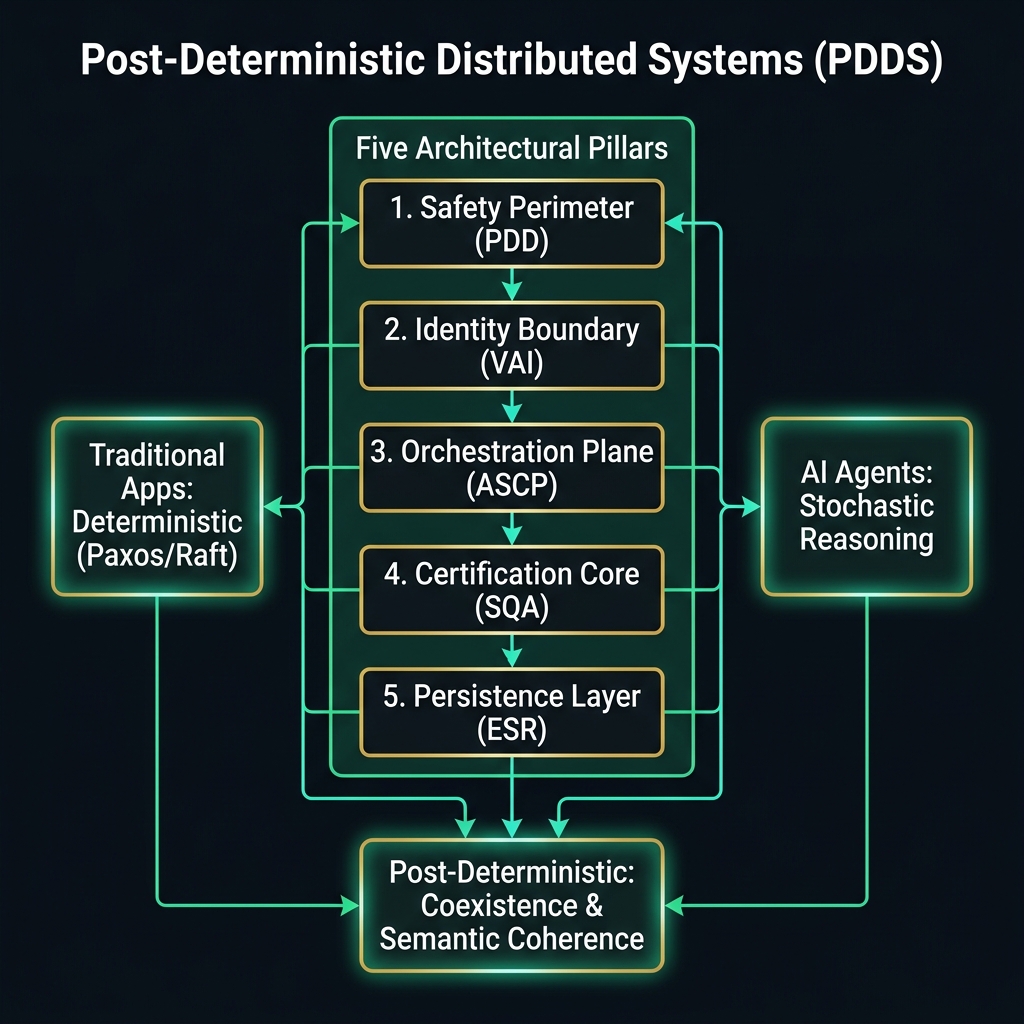
Defines machine-enforceable protocols that admit generated software and autonomous outputs only when they satisfy semantic and operational invariants.
Post-Deterministic Distributed Systems
A distributed systems paradigm for reasoning about systems whose participants exhibit bounded, governable, or irreducible non-determinism.
Classical distributed systems assumed deterministic participants and focused on networks, timing, and failures. That foundation remains essential, but it does not fully describe systems where participants interpret goals, synthesize plans, adapt workflows, or ask humans to approve consequential actions.
Post-Deterministic Distributed Systems (PDDS) extends the model to include non-deterministic participants such as AI agents, autonomous services, adaptive workflows, and human-in-the-loop components. PDDS treats deterministic services as the zero-ambiguity limit case inside a broader governable participant model.
The pillar names follow the terminology defined in the PDDS paper and manifesto.
Defines machine-enforceable protocols that admit generated software and autonomous outputs only when they satisfy semantic and operational invariants.
Replaces static credentials with intent-based authorization, ephemeral delegation, and evidence-backed execution identity.
Separates high-variance reasoning from direct state mutation while preserving intent across asynchronous execution.
Certifies meaning, intent, policy, and evidence across diverse participants instead of relying only on bitwise agreement.
Replicates knowledge states and belief lineage while preserving cognitive diversity and enabling semantic rollback.
The canonical research artifact is the arXiv paper, with the OpenKedge paper page serving as the HTML reading and sharing surface.
Use Post-Deterministic Distributed Systems (PDDS) on first mention, then PDDS thereafter. This keeps citations, discussions, and technical references converged on one short term.
PDDS is a distributed systems paradigm for reasoning about systems whose participants exhibit bounded, governable, or irreducible non-determinism.
PDDS stands for Post-Deterministic Distributed Systems.
Classical distributed systems primarily model deterministic participants under network, timing, and failure constraints. PDDS extends that model to include non-deterministic participants such as AI agents, autonomous services, adaptive workflows, and human-in-the-loop components.
PDDS is the commonly used acronym for Post-Deterministic Distributed Systems.