Vision 2030 & Sovereignty
Protects sensitive government data. Employs obfuscation membranes and strongly-typed translation layers to prevent raw, unredacted context from leaking to external model APIs.
The primary boundary of the Autonomous State Control Plane isolates reasoning from execution. Although artificial intelligence agents can generate plans, propose infrastructure modifications, draft administrative decisions, and recommend operational adjustments, capability does not imply authority. Sovereign Agentic Loops (SAL) partition systems so that reasoning stays outside the execution boundary and consequential state changes remain under institutional control.
SAL decouples the locus of reasoning from the seat of authority. Under this architecture, AI agents assist in planning, analysis, summarization, and decision support without possessing execution privileges. The control plane treats model reasoning as advisory input, never as an intrinsic source of authority.
SAL Doctrine
AI reasoning proposes; sovereign governance decides. Execution must remain inside the institutional control boundary.
Sovereign Agentic Loops formalizes this separation in greater detail [1].
The Reasoning-Execution Boundary
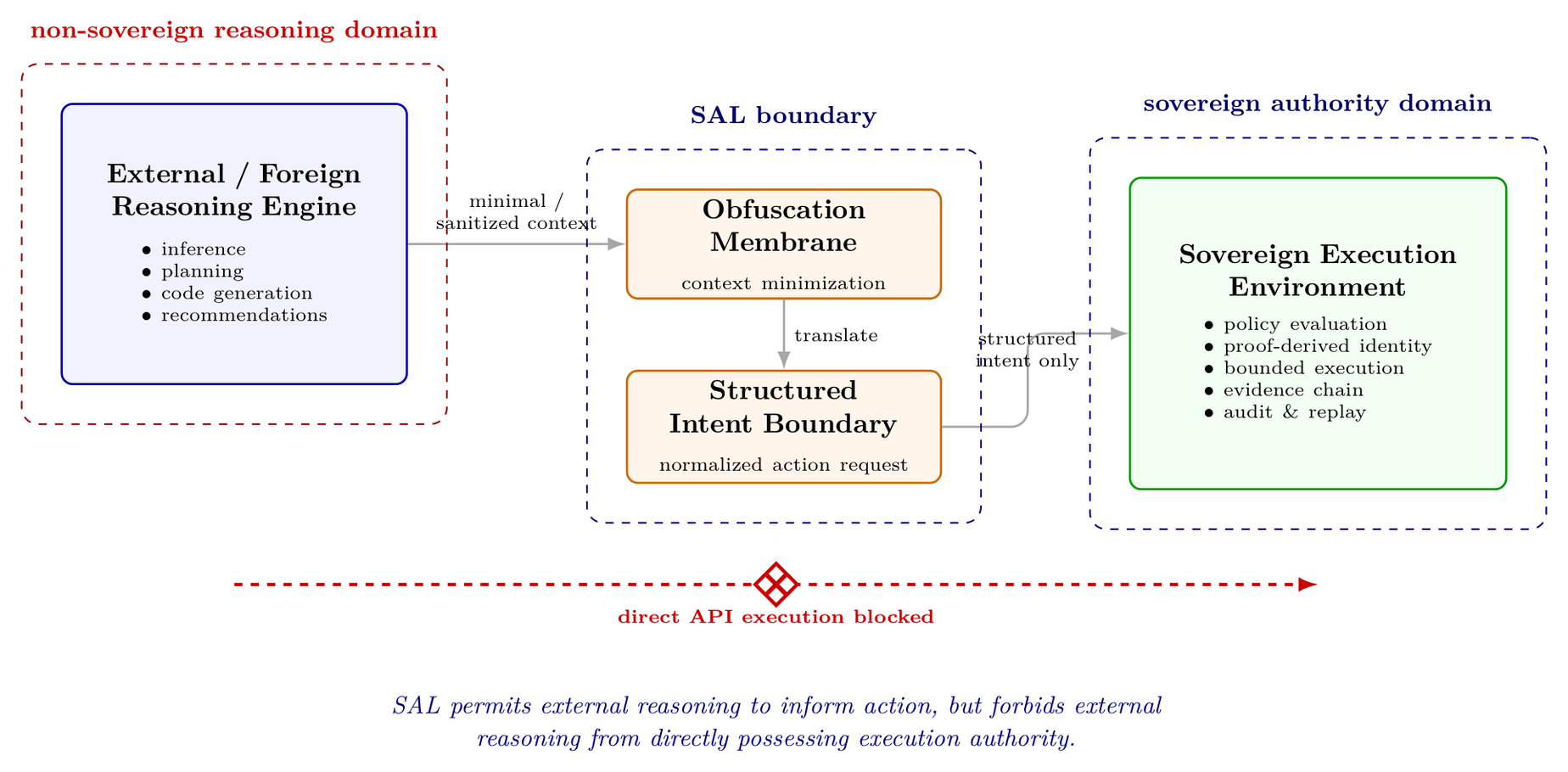
Autonomous control systems divide operationally into two distinct domains. The first, the reasoning domain, encompasses model inference, planning, code generation, tool selection, and semantic recommendation. Within this domain, an AI system constructs candidate interpretations of objectives and proposes prospective actions.
The second, the execution domain, governs infrastructure mutation, credential issuance, code deployment, financial transactions, and any state-mutating operation. In the execution domain, institutional accountability becomes concrete: resources are provisioned, records updated, permissions granted, and code admitted. SAL prevents the collapse of these domains into a single, unmonitored loop by requiring reasoning to remain external while keeping execution strictly inside the sovereign boundary.
This boundary does not divide humans from machines; it separates proposal from authority. An operator can propose unsafe actions; a deterministic routine can execute in an incorrect scope; a model can generate an optimal plan. Architecturally, the origin of the proposal is secondary. The primary concern is whether the system treats that proposal as advisory or endows it with immediate mutation authority.
This distinction enables institutions to use advanced machine intelligence without permitting models to become the actors of record. While a model may analyze data, draft configurations, or suggest remediations, the sovereign control plane determines admissibility, enforces scope, justifies authority, verifies evidence, and triggers escalation.
Engineers evaluating agent integrations must ask where reasoning stops and institutional authority begins, not only whether an agent can complete a task. Granting a model direct write access to production systems violates this boundary regardless of prompt-level safeguards. Requiring the model to generate structured, non-executable intent that passes through local governance establishes the baseline for sovereign autonomy.
What Makes an Agentic Loop Sovereign
An agentic loop consists of a recurring cycle: the system observes context, reasons about objectives, proposes actions, receives feedback, and updates its strategy. Traditional agent architectures implement this loop via iterative model calls, direct tool execution, memory retrieval, and self-evaluation.
This loop introduces systemic risk when actions execute directly. When an agent observes state, reasons about a goal, calls privileged APIs, and recursively invokes further tools based on the results, it operates as an autonomous actor. Under this model, any error in reasoning, tool selection, or state interpretation mutates the target system unchecked.
A sovereign agentic loop structurally prevents the reasoning process from directly mutating sovereign systems. Every proposed action must cross an intent boundary for evaluation by a control plane operating under local institutional authority. The loop becomes sovereign only when the institution owns the interface through which reasoning translates into execution.
Sovereignty here is operational, not symbolic. It requires local control over policy, execution authority, evidence collection, audit trails, escalation protocols, and context disclosure. The responsible institution, rather than an external provider, dictates which policies apply, which actors may request mutations, what data may be exposed to the model, and what evidence must be preserved.
The agentic loop remains dynamic, iterative, and capable of utilizing environmental feedback. However, it cannot unilaterally cross the boundary from proposal to execution; that transition requires explicit governance.
This constraint becomes more important when agents maintain memory, planning state, tool-use histories, and self-reflection loops. These internal mechanisms may improve proposal quality, but they complicate inspectability. A sovereign loop treats internal agent state as reasoning telemetry, not authority. Memory may inform a proposal, and planning traces may support a justification, but neither grants execution rights. The control plane derives authority from structured intent, active policy, verified context, and evidence.
Foreign Reasoning, Local Authority
In this architecture, the term foreign denotes any system external to the sovereign execution boundary, rather than a hostile entity.
Foreign Reasoning, Sovereign Execution
Foreign does not mean hostile; it denotes any logic external to the sovereign execution boundary. External reasoning advises; sovereign execution decides.
Foreign reasoning encompasses frontier models hosted by external vendors, third-party agents, cross-border inference services, open-source models running outside the local boundary, or even internal models operating outside a specific department's authority. While these reasoning systems generate valuable outputs, they lack the legal or operational authority to mutate system state.
This framing avoids two architectural extremes: uncritical dependence, which permits capable models to mutate infrastructure based on plausible plans, and strategic isolation, which rejects external intelligence due to boundary concerns. SAL establishes a third pattern: external reasoning may advise, but local authority must decide. The risk is not the existence of external reasoning, but the delegation of authority to it.
This follows directly from the sovereignty model established in Chapter 3. A nation or enterprise can use external models while maintaining local control over data boundaries, policy, identity, execution, and audit. The control plane does not need to own the model to control execution; it must own the boundary where model output translates into governable intent.
This principle applies equally to internal enterprise systems. A central AI service may serve multiple business units, but remains "foreign" to any specific authority boundary. For example, a corporate LLM is foreign to a financial approval pipeline, a healthcare data enclave, or a production operations cluster. Thus, SAL represents not only a geopolitical tool but an institutional control pattern for any environment requiring shared reasoning under localized authority.
The Obfuscation Membrane
The obfuscation membrane regulates the flow of information into the reasoning domain. This controlled interface translates sovereign operational context into abstracted, task-specific representations before transmitting it to external or non-authoritative models.
The membrane minimizes context disclosure, shielding sensitive operational state, private data, and infrastructure topology. It presents only the minimum context necessary for effective reasoning while retaining complete sovereign control.
The membrane is more than a passive data-redaction filter. Redaction masks specific fields; the obfuscation membrane determines the conceptual representation of the problem exposed to the reasoning layer. For example, it might summarize a dependency graph rather than expose raw network topology, specify a resource class rather than disclose physical identifiers, or present policy-relevant constraints without revealing full internal policy rules. It tokenizes citizen, patient, or system identifiers, exposing the existence of operational constraints without disclosing their sensitive details.
The obfuscation membrane ensures the reasoning layer receives sufficient context to propose solutions, but never enough system-level detail to seize control.
Maintaining this equilibrium is an engineering task. Over-restriction starves the model of necessary context, rendering its proposals generic and ineffective. Excessive disclosure leaks sensitive data and exposes operational details that could facilitate unauthorized control if secondary boundaries fail. A mature SAL implementation manages context exposure as an explicit, policy-driven decision rather than a configuration convenience.
In cloud operations, the membrane discloses that a service is critical and currently under a change freeze without revealing network topologies or environment credentials. In public-sector workflows, it provides anonymized case attributes and eligibility criteria without exposing citizen identities. In automated software engineering, it provides interface contracts and test failures while withholding unrelated source code and secrets. The pattern remains uniform: the reasoning layer receives a task-shaped abstraction while the underlying sovereign context remains shielded.
The membrane's transformations should be auditable. The control plane should log what context was disclosed, what was withheld, which abstraction rules were applied, and the justification for that representation. This auditability prevents context minimization from becoming an opaque policy bypass and helps trace the root causes of poor model proposals. If a model fails to produce a viable plan due to insufficient context, engineers should refine the membrane's translation rules rather than bypass the boundary.
Intent Isolation
SAL prohibits the direct conversion of external reasoning outputs into API calls. Instead, all model outputs must undergo translation into structured intent. This process of intent isolation converts plans, recommendations, or tool calls into strongly-typed objects that the control plane can govern.
A valid intent object specifies the requested action, underlying objective, target scope, origin, assumptions, expected blast radius, risk classification, and justification. This format must be machine-readable to allow automated policy evaluation, and human-readable to facilitate manual review. The intent should also contain provenance metadata identifying the model, agent version, user request, and system state that initiated the proposal.
Intent represents the admissible reasoning output allowed to cross the boundary into the governance layer. Raw model text, generated scripts, natural-language rationales, and tool-call payloads carry no intrinsic authority.
SAL converts model output from a command into a governable claim.
This claim proposes that a specific action is justified under a defined objective and scope. The claim may be valid, over-broad, context-starved, or subject to rejection. The model does not execute actions; it submits proposals for inspection by the control plane.
Intent isolation also mitigates the risk of tool-chain amplification, where a minor reasoning error cascades into a destructive sequence of API calls. For example, an unconstrained agent might select the wrong target resource, attempt to adjust its configuration, deploy a patch to resolve the resulting error, and escalate its own permissions to bypass a block. Intent isolation aggregates these proposed operations into a single intent object before execution. The control plane evaluates the proposed sequence, including blast radius, dependencies, and compliance, before a state change occurs.
The intent object must be syntactically narrow yet semantically rich. While a weak intent specifies only a command like "restart service," a strong intent details the target resource, the operational objective, the proposed execution window, expected side-effects, rollback procedures, and the specific evidence to be collected. This structured richness allows the governance layer to verify alignment with user intent, simulate outcomes, and flag high-risk proposals for human escalation.
Intent isolation also supports vendor and model neutrality. Because the control plane mandates a standardized, structured intent format, the underlying models and agent frameworks can be swapped, upgraded, or run in parallel without altering the system's authority boundary.
Compositional Governance
Governing agentic workflows requires maintaining authority across composite operations, especially when agents delegate tasks, chain tools, spawn sub-agents, or dynamically modify execution paths.
Agentic systems are inherently recursive. A parent loop may invoke a sub-loop, delegate to a specialized model, generate a dynamic workflow, or request a code-generation tool to synthesize a runtime adapter. If the parent loop is governed but its delegated sub-processes bypass inspection, the architecture merely shifts the vulnerability. A sovereign agentic loop must enforce governance invariants across all composite execution paths.
Delegation never automatically transfers authority. Sub-agents must not inherit the parent's broad permissions. Instead, the control plane must issue narrow, task-scoped execution contracts justified by the sub-agent's specific intent, context, active policy, and evidence requirements. Every composite action must cross the intent boundary.
SAL therefore defines a boundary condition: a composed loop is admissible only if the resulting composite workflow preserves sovereign control. Sub-intents must remain explicit, delegated actions require independent contracts, and sub-agents cannot inherit parent privileges. Evidence chains must preserve parent-child provenance so the composite workflow can be replayed, while governance policy must explicitly regulate delegation.
In formal terms, governed actions represent composable state transformations. Category theory provides a useful model for reasoning about these structures: if each constituent transformation preserves the governance boundary, the composite morphism preserves that boundary as well. This whitepaper does not mandate a category-theoretic implementation. The operational goal is simpler: prevent composition from becoming a policy bypass.
For foundational approaches to these formalizations, see categorical semantics [2], compositional verification [3], and denotational semantics [4].
Sovereign Execution Environment
Once intent crosses the boundary, execution proceeds exclusively within the sovereign execution environment. This domain governs context verification, policy evaluation, execution contract generation, cryptographic identity derivation, execution adapters, evidence recording, and replay auditing.
While the reasoning system proposes the objective, the sovereign environment determines admissibility. This functional separation lets SAL compose with the broader Autonomous State Control Plane: SAL enforces the reasoning boundary, OpenKedge evaluates the resulting intent, VAI derives runtime authority, the IEEC anchors the decision and execution history, and PDD governs generated code before admission.
The sovereign execution environment is defined by administrative control rather than physical isolation. While on-premises datacenters or sovereign clouds may host the environment, its defining characteristic is authority: the managing institution must control the policy engines, identity providers, execution contracts, and evidence boundaries. Workflows can span public clouds and leverage external inference APIs as long as the execution authority resides within the institutional control plane.
The environment must also enforce escalation paths. High-risk or ambiguous intents should not be resolved through automated heuristics alone. They should route to human operators, simulation sandboxes, or immediate rejection. Sovereign execution includes the authority to deny automation.
Execution adapters must operate under strict constraints. These adapters must not accept unverified instructions directly from the reasoning layer; they should execute only signed contracts issued by the control plane. If an adapter remains callable by the agent runtime directly, the sovereignty boundary has collapsed. A robust implementation makes the governed, policy-checked path the sole approved mechanism for system mutation.
Architecturally, the sovereign execution environment serves as a "narrow waist." Reasoning engines, model providers, and agent frameworks may vary and evolve. Target systems, including cloud platforms, databases, and operational APIs, remain heterogeneous. Between them stands a single, invariant gateway: intent enters, governance evaluates, contracts constrain, identity authorizes, and the evidence chain records the outcome.
Failure Modes Prevented by SAL
SAL provides a governance layer that prevents or mitigates several failure modes that emerge when reasoning and execution collapse.
Authority Confusion
Without a reasoning-execution boundary, institutions risk treating model-generated outputs as de facto authority. SAL prevents this by ensuring model output crosses the boundary strictly as intent, never as an executable command.
| Failure Mode | Risk | SAL Response |
|---|---|---|
| Direct model execution | Model output directly mutates production state | Forces all actions to cross a structured intent boundary |
| Over-disclosure | Exposes sensitive data or system details unnecessarily | Restricts exposure via the obfuscation membrane |
| Authority confusion | Obscures whether a model or an institution authorized an action | Retains execution authority within the sovereign control plane |
| Tool-chain amplification | Cascades minor reasoning errors into multiple destructive API calls | Aggregates proposed operations into single governed intents before execution |
| Policy bypass | Avoids institutional compliance and safety checks | Enforces deterministic policy evaluation prior to mutation |
| Audit weakness | Fails to trace execution back to underlying reasoning | Binds intent, decisions, and execution via cryptographic evidence chains |
| Vendor coupling | Hardcodes governance into specific model providers | Standardizes reasoning interfaces to maintain provider neutrality |
The common denominator in these failure modes is the unconstrained translation of output to action. SAL interrupts this translation. It forces the reasoning layer to generate proposals and charges the control plane with evaluating whether those proposals should proceed.
This is a deliberate architectural discipline, not a rejection of AI capabilities. Highly capable models can generate planning outputs superior to traditional scripts. Precisely because these models are powerful enough to be integrated into public services, infrastructure, and regulated systems, they require a boundary that protects execution authority from direct model action.
These failure modes show why prompt-level safety guidelines or basic tool allowlists are insufficient. A prompt instructing an agent to act safely can be bypassed; tool allowlists do not evaluate semantic context; post-hoc logging only records failures after they occur. SAL restructures the system architecture so that reasoning engines cannot mutate state through approved interfaces, reducing whole classes of failure by design.
How SAL Composes with OpenKedge
SAL provides the architectural boundary that makes formal governance possible.
The handoff is straightforward: SAL creates the boundary, and OpenKedge governs what crosses it.
The control-plane lifecycle maps as follows:
OpenKedge depends on SAL to supply a structured, governable input. Without SAL, models attempt direct tool invocation. Under SAL, model outputs must undergo normalization into intent objects. OpenKedge then evaluates these objects against active policies, current context, risk classifications, blast radius, evidence rules, and escalation thresholds.
This boundary also supports auditable replay. When investigating past actions, auditors can distinguish reasoning telemetry from structured intent, policy decisions, execution contracts, runtime identities, and execution events. This structural separation prevents accountability from collapsing into the vague claim that the AI made the decision.
This composition also clarifies operational ownership. The model provider remains responsible for model performance within its service boundary, while the institution retains policy and execution authority. OpenKedge owns the governance decision, VAI derives runtime authority, the IEEC secures the evidence chain, and PDD governs code admission. SAL stands as the gatekeeper, preventing direct model output from bypassing this chain.
Design Requirements
Implementing SAL requires structural constraints that make direct execution physically impossible.
- No direct mutation from the reasoning layer. Models and agents must never call privileged APIs directly. Mutating tools must terminate at the control plane, outside the model's runtime environment.
- Structured intent as the boundary artifact. The system must represent every proposed action as a machine-readable intent object before policy evaluation.
- Minimal context disclosure. The obfuscation membrane must limit context exposure to the minimum required for the task.
- Local policy authority. The control plane must evaluate all policies locally within the sovereign boundary.
- Execution identity outside the reasoning layer. The system must issue cryptographic credentials only after policy approval, never directly to the model.
- Evidence binding. The control plane must bind reasoning outputs, intents, decisions, contracts, and execution events into a single, tamper-evident chain.
- Model neutrality. The boundary interfaces must remain model-agnostic, supporting upgrades, local models, or multi-model architectures without altering the execution path.
- Escalation paths. The system must route high-risk or ambiguous intents to manual review, simulation, or refusal.
These requirements translate sovereignty into engineering practice. They allow agentic reasoning to be used while preventing models from acquiring system authority. They also give platform teams a concrete governability test: map every path from model output to state mutation and verify that each path crosses the intent boundary before execution.
The next chapter develops the governance engine that receives these intents and turns them into policy-evaluated execution contracts: OpenKedge intent governance.
References
- [1]He, Jun; Yu, Deying. Sovereign Agentic Loops: Decoupling AI Reasoning from Execution in Real-World Systems. arXiv preprint arXiv:2604.22136. 2026. arXiv
- [2]Benjamin C. Pierce. Basic Category Theory for Computer Scientists. MIT Press. 1991.
- [3]Willem-Paul de Roever; Hans Langmaack; Amir Pnueli. Compositionality: The Significant Difference. Springer-Verlag. 1998.
- [4]Winskel, Glynn. The Formal Semantics of Programming Languages: An Introduction. MIT Press. 1993.